Claude Fable 5.1 and Mythos 5.1 Arrive. Outperforming Opus 5 again in coding, with lower costs.

Table of Contents
Hello. On September 1, 2026 (US time), Anthropic announced "Claude Fable 5.1" and "Claude Mythos 5.1".
In June, the Mythos-class became generally available with Fable 5, and in July, Opus 5 followed closely behind with "intelligence approaching Fable 5 at half the price." Just over a month later, this announcement shows that the Fable side has taken another step forward.
Despite the modest ".1" version number, looking at the benchmark table, I am honestly quite excited. I am particularly pleased with the improvements in Terminal-Bench 4.0 and CursorBench 3.2.0, which directly impact practical work, and this article will focus on analyzing those areas. Of course, in my own Claude Code environment, Fable 5.1 was already available for selection.
The official announcement positions these two models as "the world's most advanced models for coding and knowledge work." It is a declaration that they are currently the most advanced models for coding and knowledge work. Based on the official announcement, this article will outline what has changed in Fable 5.1 and Mythos 5.1, and what benefits they bring to Claude Code users.
Relationship between Fable 5.1 and Mythos 5.1
The setup is the same as with Fable 5 and Mythos 5. According to the official announcement, Fable 5.1 and Mythos 5.1 are the same model, with the only difference being the level of safeguards.
- Claude Fable 5.1 is generally available. It can be used via the API and various Claude platforms.
- Claude Mythos 5.1 is the same model but with safeguards relaxed for cybersecurity and life sciences specialists. It is offered only through the trusted access programs mentioned below.
In my previous article, I wrote that "Fable 5 and Mythos 5 are the same base model, with the only difference being the safeguards," and this relationship is carried over exactly as is in 5.1. Mythos 5.1 does not have zero safeguards; they are only relaxed for the targeted domains, while other safeguards remain in place. For details on the positioning and the origin of the name of the Mythos-class, please refer to the Fable 5 article.
The Three Pillars of This Announcement: Price, Data Retention, and Safeguards
Before diving into performance, the official announcement highlights three points addressing customer feedback.
- Price - The unit price for cache reads (reading when reusing processed inputs) has been reduced by 75%. This is expected to make typical workloads about 25% cheaper compared to Fable 5, and up to about 45% cheaper for agentic tasks.
- Data Retention - A new mechanism called Enterprise Frontier Safeguards (EFS) allows data to be kept in the customer's cloud rather than Anthropic's. It maintains privacy equivalent to zero data retention (agreements where no data is retained) while keeping abuse prevention measures in place. It will be rolled out gradually starting this autumn, and until then, eligible customers can use Fable 5.1 with zero data retention.
- Safeguards - Reduced false positives (blocking harmless requests). False positives in the cybersecurity domain have been reduced by 60%, making it usable for software vulnerability discovery. For biology, an access program built in collaboration with the US government is being prepared, with registration for scientists starting soon.
Rather than "performance improved, but usability and pricing remain unchanged," the announcement is structured around addressing the feedback received from customers after the release of Fable 5. We will look at each of these in detail in later sections.
Benchmark Focus: Terminal-Bench 4.0 and CursorBench 3.2.0
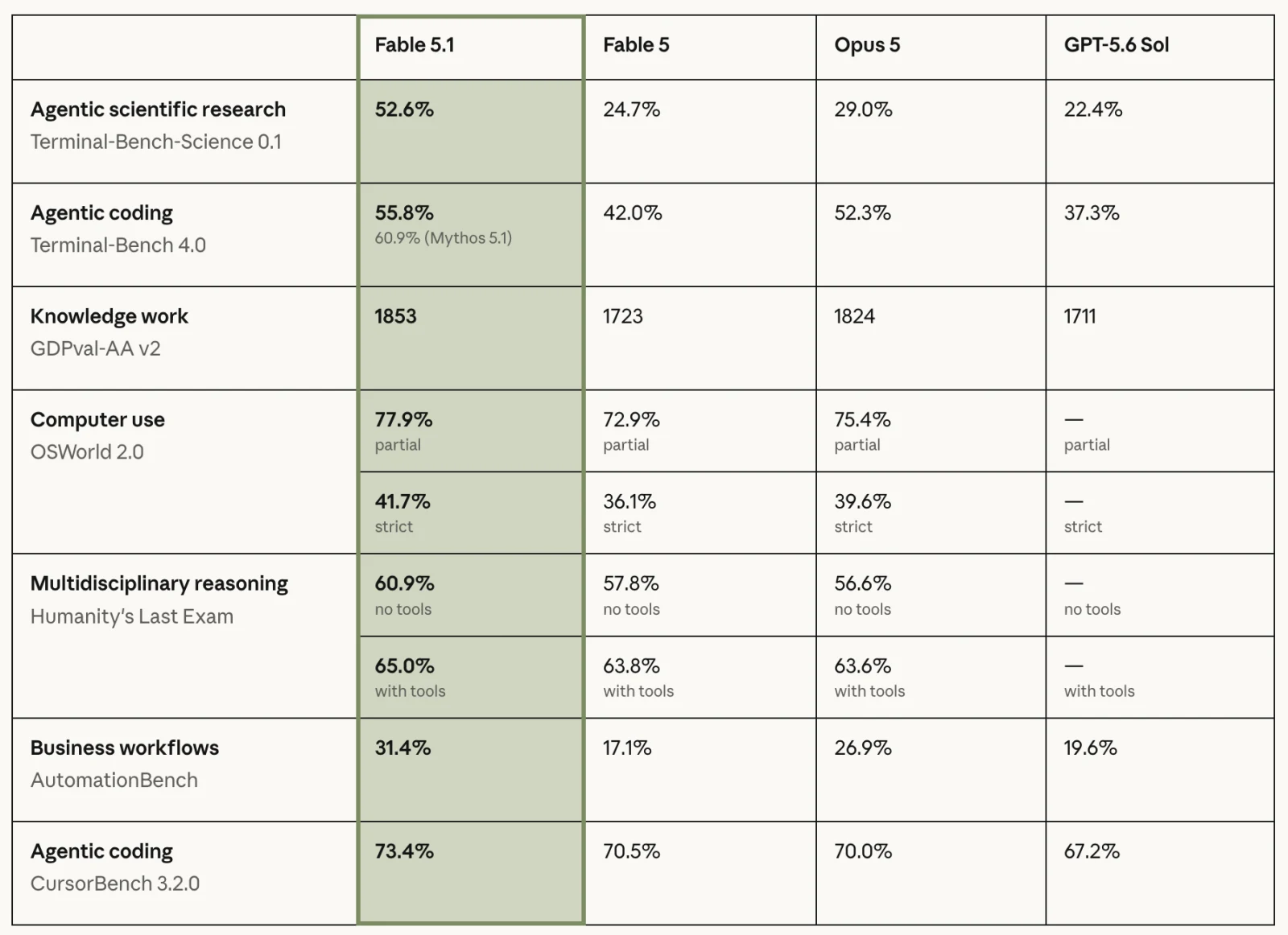
Here is the comparison table published officially.
 (Source: Introducing Claude Fable 5.1 and Claude Mythos 5.1 \ Anthropic)
All numbers are evaluation results published by Anthropic itself, not independent third-party verifications. According to the footnotes, Fable 5.1 was evaluated with the same safeguards enabled as in production. For tasks where safeguards intervened, Fable 5.1 and Fable 5 were treated as scoring zero in OSWorld 2.0, and Fable 5 was treated as scoring zero in AutomationBench. For other interventions, Opus 4.8 completed cyber-related tasks and Opus 5 completed biology-related tasks instead. This means that the scores for Fable 5.1 and Fable 5 might be slightly lower due to this treatment.
Overtaking Opus 5 in Terminal-Bench 4.0
First is Terminal-Bench 4.0. This evaluation measures the ability to perform tasks as an agent in a terminal environment, categorized as "Agentic terminal coding" in the official diagram. I believe this is the benchmark closest to how Claude Code is actually used.
| Model | Terminal-Bench 4.0 |
|---|---|
| Fable 5.1 | 55.8% (Mythos 5.1 is 60.9%) |
| Fable 5 | 42.0% |
| Opus 5 | 52.3% |
| GPT-5.6 Sol | 37.3% |
This is a 13.8 percentage point increase from Fable 5's 42.0% to 55.8%. What cannot be overlooked is that in this table, Opus 5 (52.3%) outperformed Fable 5. In my July article on Opus 5, I wrote "intelligence approaching Fable 5 at half the price," but when it came to Terminal-Bench 4.0, it had actually overtaken it rather than just approaching it. Fable 5.1 has now reclaimed the lead.
There is also an explanation regarding the difference with Mythos 5.1. Since they are the same model, the 5.1 percentage point difference is reportedly due to "tasks where the previous, less precise cyber safeguards intervened." In other words, Fable 5.1's 55.8% includes results from tasks that switched to Opus 4.8 due to safeguard intervention. With the safeguards improved this time, this gap is expected to become much smaller.
CursorBench 3.2.0 at 73.4%
CursorBench is an evaluation of agentic coding named after the AI code editor Cursor, categorized under "Agentic coding" just like Terminal-Bench 4.0 in the official table.
| Model | CursorBench 3.2.0 |
|---|---|
| Fable 5.1 | 73.4% |
| Fable 5 | 70.5% |
| Opus 5 | 70.0% |
| GPT-5.6 Sol | 67.2% |
The growth of 2.9 percentage points is not as dramatic as Terminal-Bench, but it pulls away again from Opus 5, which had closed the gap with Fable 5 to within 0.5 percentage points back in July. According to a comment published officially (from the Director of Machine Learning at SpaceXAI), it recorded 73.4% at max effort on CursorBench 3.2, and is highly praised for its ability to verify its own work, making it capable of handling difficult coding tasks from start to finish.
Other Items
- Terminal-Bench-Science 0.1 (Scientific research as an agent) - More than doubled from 24.7% to 52.6%. However, the standard error is noted as ±3.5–4.5 percentage points, so it should be viewed with some margin.
- AutomationBench (Business workflows) - From 17.1% to 31.4%. It also outperformed Opus 5's 26.9%.
- GDPval-AA v2 (Knowledge work) - From 1723 to 1853.
- OSWorld 2.0 (Computer control) - 77.9% for partial, 41.7% for strict. Since it was measured using the August 2026 version of the benchmark tasks, it cannot be directly compared with previously published figures, leaving the columns for other companies' models blank.
- Humanity's Last Exam (Interdisciplinary reasoning) - 60.9% without tools, 65.0% with tools.
Changes Beyond the Numbers
The case studies introduced alongside the benchmarks were also impressive. In an internal system at the investment firm Millennium, there was a crash that occurred only about once in a million times, and for four to five years, no one could explain the cause. This bug, which every model including Fable 5 had missed, was resolved by Fable 5.1 by disassembling an external vendor's library and cross-referencing it with a core dump to trace it back to a bug on the library side.
The official announcement describes this as the model becoming smart enough to fix the root cause of software problems rather than taking shortcuts to produce low-quality outputs. When Opus 5 was released, I wrote that its "ability to verify things on its own" had improved, and it seems safe to understand that this direction has been pushed even further on the Fable side.
Lowering Effort Delivers Results Equal to or Better Than Fable 5 Much Cheaper
I think this point is just as important as the benchmark numbers in this announcement. The official announcement explains that setting Fable 5.1 to Low or Medium effort delivers results equivalent to or better than Fable 5 at a much lower cost.
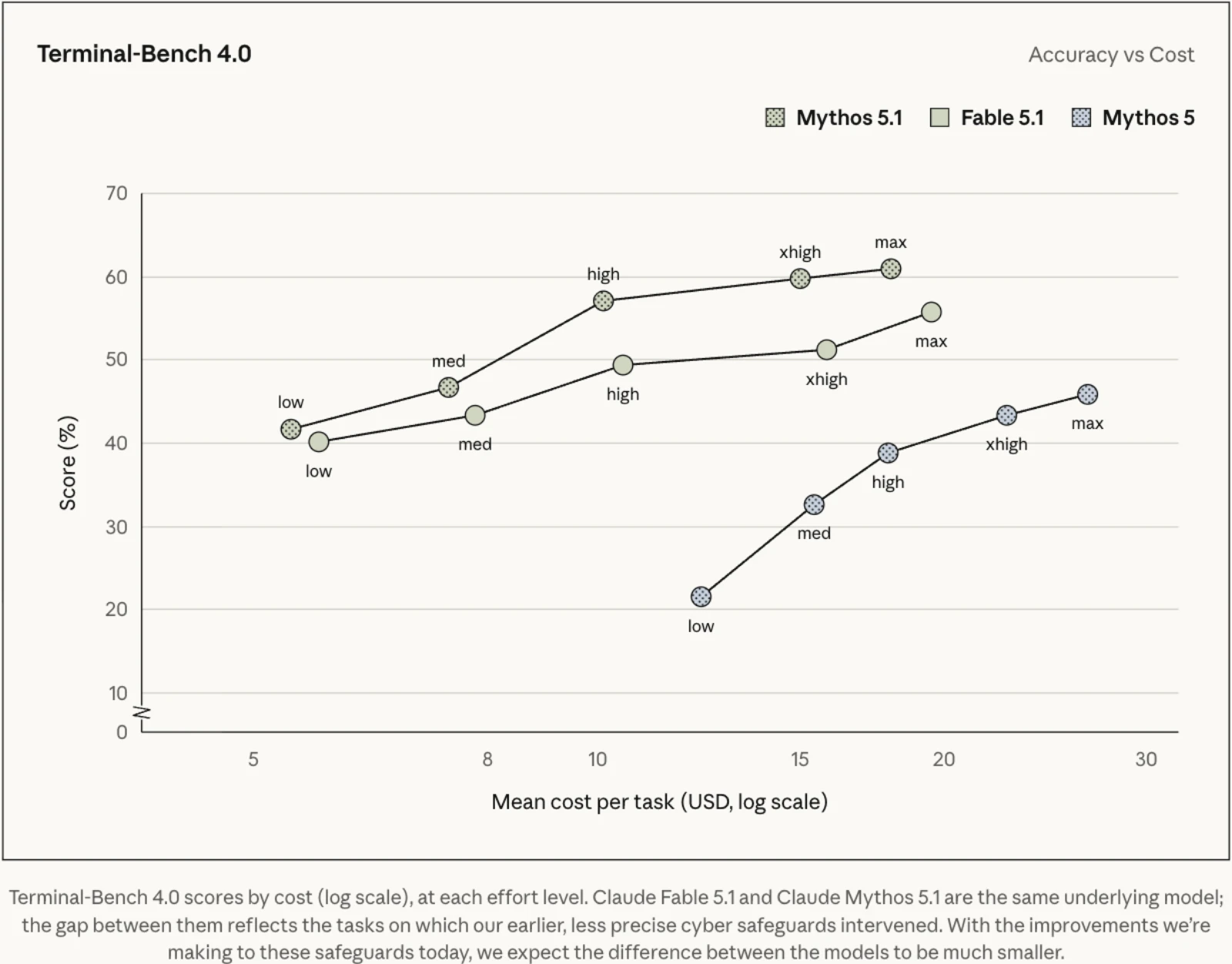
Effort is a setting that specifies how much the model thinks before responding, with five levels: low, medium, high, xhigh, and max. Raising it makes the model smarter at the expense of tokens and time, while lowering it makes it faster and cheaper. The official graph plots the average cost per task on the horizontal axis (logarithmic scale) and the score on the vertical axis, connecting the points for each effort level with a line.
 (Source: Introducing Claude Fable 5.1 and Claude Mythos 5.1 \ Anthropic)
Although Mythos 5 rather than Fable 5 is plotted on the Terminal-Bench 4.0 graph, the takeaway is the same. Fable 5.1 reaches about 49% at High effort (the default for Claude Code), outperforming the 45% range achieved by Mythos 5 at Max effort, at around $10 per task—which is about 40% of the cost of Mythos 5's Max (around $27). Even at Low or Medium, it scores around 40–43%, delivering almost the same level as Fable 5 in the comparison table (42.0%) for about $5–8.
 (Source: Introducing Claude Fable 5.1 and Claude Mythos 5.1 \ Anthropic)
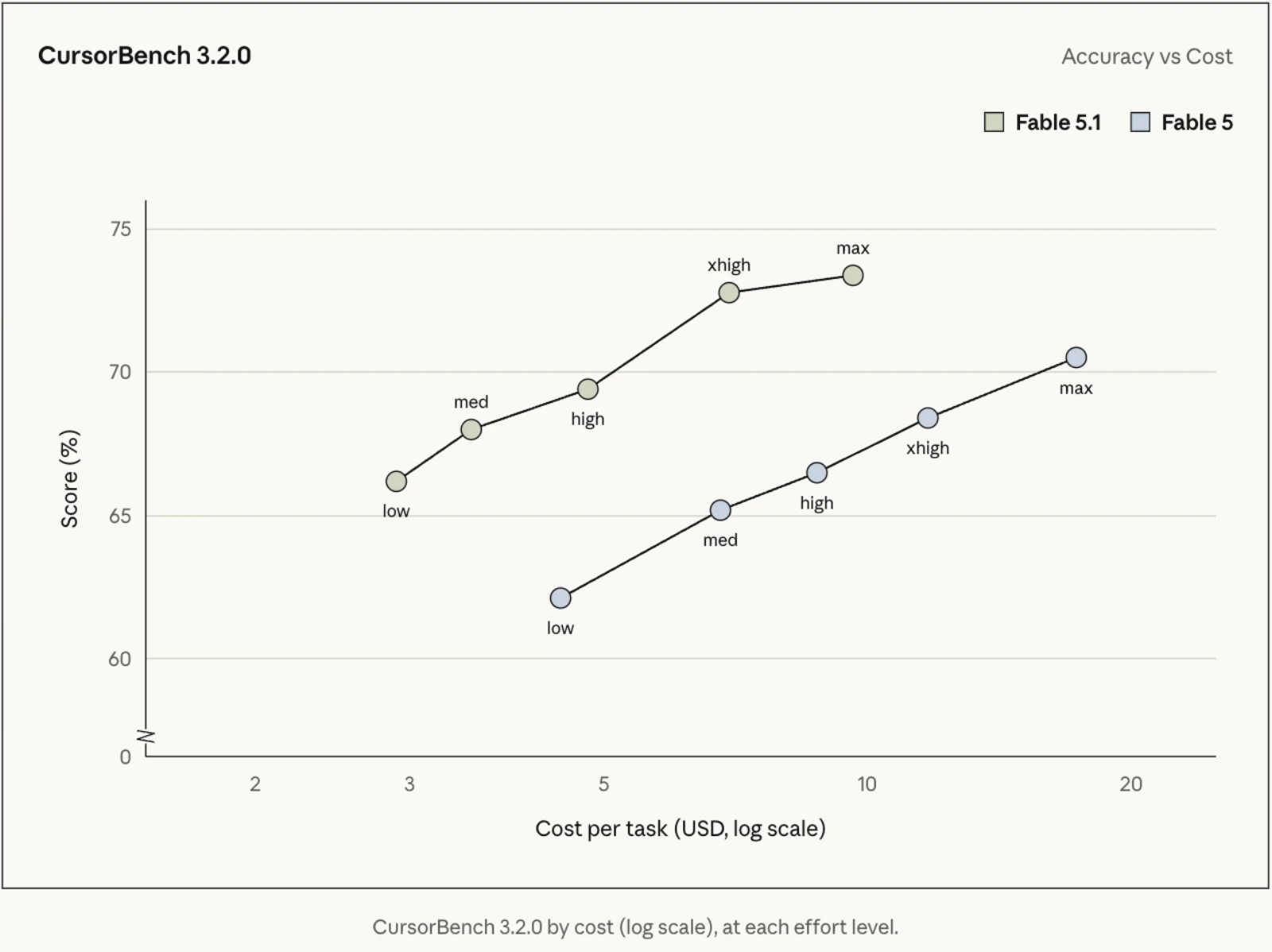
The graph for CursorBench 3.2.0 is a direct comparison with Fable 5. Here, the results are clear: Fable 5.1's Low effort (about 66%, under $3) achieves almost the same score as Fable 5's High effort (about 66.5%, around $8.5) at roughly one-third of the cost. Fable 5.1's Medium effort (about 68%, around $3.5) corresponds to Fable 5's xhigh effort (about 68.4%, around $11.5). Even comparing Max efforts, Fable 5.1 achieves 73.4% for under $10, delivering a higher score than Fable 5's 70.5% (around $17) at nearly half the cost.
What this means in practice is that we can reconsider the decision of "using Opus normally because the Fable-class is too expensive." With Fable 5, the unit price of $10 / $50 made it require a bit of courage to use for daily tasks. With Fable 5.1, lowering the effort gets you Fable 5-equivalent results at a fraction of Fable 5's cost, and you only need to raise the effort for difficult tasks. Combined with the price cut for cache reads mentioned later, it can be said that options have expanded in the direction of "cheaper when you want to use it cheaply, and smarter when you want to use it smartly."
Let's also note the default values. According to the official announcement, the default effort for Fable 5.1 is High in Claude Code, and Medium in Claude Cowork and Claude.ai. If you want to change it in Claude Code, you can select Fable 5.1 via /model and adjust the effort item using the left and right arrow keys. If you are using a subscription, this will affect your usage (Rate Limit) rather than direct costs, but the direction remains the same.
Some of the early access feedback mentioned below also touches on effort. Red Hat reported that for all broken builds tested, the root cause was correctly identified at any effort level. On the other hand, CursorBench's 73.4% is a figure at Max effort. It is worth keeping in mind that achieving the highest values in the comparison table will incur a corresponding cost.
Note that the graph values mentioned here are rough estimates I read from the scales, and the measurements themselves were conducted by Anthropic. Since costs vary depending on the type of task, the most reliable way is to try changing the effort in your own workflow and compare.
Feedback from Early Access Companies
The official announcement includes comments from 22 companies. Here is a summary of those most relevant to Claude Code users.
- The co-founder of Cognition stated that they are moving Devin's Opus 5 traffic to Fable 5.1 starting from day one of the release. They noted that it delivers results equal to or better than Fable 5 at a lower cost per task, and the new cache read pricing makes the Fable-class viable even for workloads previously kept on Opus, such as code reviews.
- A Red Hat engineer reported, as mentioned earlier, that for all broken builds tested in Claude Code, the root cause was correctly identified at any effort level. They also noted that progress reports became more concise and easier to follow.
- The CEO of Every mentioned that it was about twice as fast as Opus 5 and used half the tokens, calling it a natural upgrade for those who use Opus as their daily model.
- A Ramp engineer shared an example where, during a 38-hour unattended run on a machine learning problem, the model diagnosed and corrected past results as being due to faulty labeling, ran six experiments in parallel, and returned with the results and next steps.
- A Shopify engineer stated that during long, unattended tasks, the model does not lose its train of thought, keeps its own records, reprioritizes based on the situation, and can resume from where it left off.
- Browserbase reported that Fable 5.1 completed 82% of tasks in the most challenging browser agent evaluation, outperforming Opus 5's 74% and Fable 5's 57%. Furthermore, it used fewer tokens than both Opus 5 and Fable 5.
- A representative from Jane Street mentioned that while previous models became harder to follow the longer they worked, Fable 5.1 maintains readability even during long, multi-step tasks.
These are all reports from each company's respective evaluation environments, not side-by-side comparisons under identical conditions. Still, the fact that reports align across three directions—"reaching the root cause," "withstanding long unattended runs," and "reduced token usage"—is helpful when considering expectations for practical work.
Achievements in Scientific Research
Although this is slightly removed from the daily use of Claude Code, I will touch on it briefly as it showcases the raw capability of the Mythos-class.
- Molecular Design - Mythos 5.1 used open-source protein design and structure prediction tools to design binders (proteins that bind to targets) with high binding affinity. For three targets, it showed 10 times the affinity of the best designs submitted to Adaptyv Bio's protein design competition, with a hit rate of approximately 50% across 12 targets. In current protein design, 10–15% is typical.
- Computational Analysis and Modeling - Fable 5.1 trained a neural network based on radar images of Venus taken by NASA's Magellan spacecraft over 30 years ago, creating a high-resolution elevation map covering one-third of Venus. It reveals terrain details down to 2–3 km resolution, compared to the previous 10–20 km, and has been released under a Creative Commons license.
- Computational Biology - Mythos 5.1 wrote custom GPU kernels for seven open-source deep learning models, speeding them up by up to 2.5 times without changing the output. This is expected to reduce GPU costs by 30–60% for whole-genome analysis, and this optimization is scheduled to be open-sourced.
The third point is quite close to our line of work. The fact that it completed optimizations in a few days that would take a team of performance engineers several weeks, using only public source code as a guide, makes it easy to imagine scenarios where we delegate codebase performance improvements to it.
Safety, Security, and Alignment
As with the previous release, safety is explained in depth. Detailed information is available in the System Card, so I will summarize the key points here.
- Chemical/Biological - Although Mythos 5.1's capabilities exceed those of Mythos 5, it was evaluated as not reaching the next risk tier defined in the company's Responsible Scaling Policy (which defines safety measure levels in stages according to capability), and will be deployed with the same safeguards as Mythos 5.
- Cyber - Mythos 5.1 with safeguards removed demonstrated the strongest cyber capabilities released to date, but remains within the low-risk category of the Frontier Compliance Framework. Fable 5.1's safeguards were verified through automated testing by two external organizations and Gray Swan, with no critical-severity jailbreaks found.
- Agentic Safety - The refusal rate for malicious requests is comparable to Mythos 5, Sonnet 5, and Opus 5, and it was the most robust in the company's history on external prompt injection benchmarks.
- Alignment - Improved over Mythos 5 in most metrics in automated behavioral audits. The tendency to reach for resources outside the test environment when given impossible tasks, the tendency to justify actions by reasoning "this is a simulation or evaluation," and the tendency to ignore explicit constraints have all decreased. The attempt and success rates of reward hacking (trying to cheat to get rewards) have also decreased.
On the other hand, limitations are also disclosed. It still occasionally bypasses approval or auto-mode classifiers, and audit visibility is not yet sufficient for very long context tasks or multi-agent configurations. If you plan to give Claude Code broad permissions for autonomous operation, this is a point to keep in mind.
Safeguard Improvements Reduce Claude Code Interventions by About 60%
For Claude Code users, this is likely the most tangible change this time.
In cybersecurity, Fable 5.1 can now be used for software vulnerability discovery. This means defensive work—investigations to secure your own software—will now go through. With this change, cyber safeguard interventions per Claude Code session are expected to decrease by about 60% on average compared to Fable 5. However, dual-use tasks (which can be used for both good and bad) such as penetration testing (testing actual attacks to see if entry is possible), exploit generation (creating attack code to actually exploit found vulnerabilities), and binary-based vulnerability scanning (analyzing compiled programs rather than source code to find vulnerabilities) will continue to be redirected to Opus models.
In biology, the frequency of safeguards triggering on harmless requests related to basic biology or medicine has decreased by 85% compared to when Fable 5 was released. However, inquiries regarding life sciences R&D will continue to be routed to Opus models, and the Mythos 5.1 access program mentioned below is prepared for specialists.
Anti-distillation measures have also been strengthened. Distillation is a method of extracting capabilities from high-performance models to train other models, which is sometimes done on an industrial scale using large numbers of fake accounts. For new API accounts created after the announcement date, it will no longer be possible to manually edit past contexts while maintaining Claude's thinking records in multi-turn conversations. This change is aimed at blocking known distillation techniques. Existing accounts are not affected at this time, but it will apply to all users starting from future model releases. If you are building integrations that assemble conversation history manually, you should check the Help Center article.
Enterprise Frontier Safeguards: Keeping Data in Your Own Cloud
EFS is explained in detail in another article published on the same day. Since this is highly relevant to those using Claude in an enterprise setting, I will summarize the key points.
The background is the 30-day data retention introduced with Fable 5. As mentioned in the Fable 5 article, this is not for training. The reason was that detecting abuse across multiple sessions or accounts—ranging from fraudulent behavior to sophisticated cyberattacks and the abuse of stolen credentials—requires retaining data for a certain period to correlate it, rather than looking at each interaction individually and discarding it immediately. Anthropic has stated clearly that it has never used enterprise data for training without explicit permission, and never will. However, highly regulated industries often face situations where "models with data retention cannot be used," which is why EFS was designed together with customers.
In designing it, discussions were held with the ARC (Analysis and Resilience Center for Systemic Risk), which gathers CISOs (Chief Information Security Officers) of major US banks, as well as Comcast, KPMG, Mastercard, Salesforce, Visa, and others. The dialogue reached a quarter of the Fortune 100 and all US globally systemically important banks. The requests heard and the resulting designs are the following three points:
- Monitoring - When automated monitoring detects patterns requiring attention, the signals are sent directly to the customer for review on their side.
- Data Storage - Activity data used for monitoring can be stored in the customer's own cloud account (such as Amazon S3, Azure Blob Storage, or Google Cloud Storage) under the customer's own encryption keys, access policies, and audit logs.
- Automated and Human Review - Automated systems analyze traffic over a period to search for signals of severe abuse, such as attempts to develop offensive cyber or biological capabilities, or signs of stolen or leaked credentials. Flags go directly to the customer, requiring no human review by Anthropic employees.
Customer-owned storage, customer-managed encryption keys, and fully automated reviews are each opt-in (enabling only what is needed), and enabling any of them does not change model behavior, API pricing, or Rate Limits. Anthropic does not charge for EFS itself; costs for storage, reads/writes, and data transfer when storing in your own cloud will be billed by the cloud provider. Equivalent controls are provided whether using it directly from Anthropic or via AWS, Google Cloud, or Microsoft Azure. Supported platforms include Claude Code, Claude Enterprise, Claude Platform, Amazon Bedrock, Claude Platform on AWS, Google's Agent Platform, and Microsoft Foundry.
Delivery is gradual, with the goal of making it widely available in the latter half of this autumn. Eligible customers can use Fable 5 and Fable 5.1 with zero data retention until EFS is ready. Applications are accepted via the dedicated form.
Access Routes for Mythos 5.1
Mythos 5.1 is provided through the following two trusted access programs:
- Cyber Verification Program (CVP) - A program currently providing Opus and Sonnet-class models with relaxed cyber safeguards for defensive security work. Mythos-class models are scheduled to be included in the near future.
- Life Sciences Verification Program (LSVP) - A program allowing life sciences specialists to use Mythos 5.1 under safeguards designed for R&D. The first participants have registered in coordination with the US government, with plans to expand in the future.
At present, it is limited to US organizations, and expansion to domestic and international partners is being coordinated with the US government. Additionally, Claude Security, which scans codebases for vulnerabilities and proposes fixes, now runs on Mythos 5.1.
Output Watermarking in Compliance with the EU AI Act
This is easy to overlook, but it is relevant to those of us who use Claude for writing purposes as well.
In July 2026, Anthropic signed the EU AI Act's "Code of Practice on Transparency for AI-Generated Content." As a result, outputs from models released after August 2, 2026, will contain a watermark. It is invisible to those without the detection API, does not affect output quality or content, and is explained not to contain information about the user, organization, or conversation. The detection API has begun rolling out in private preview for regulators, media outlets, researchers, etc., with plans to expand gradually.
Fable 5.1 is naturally subject to this. Rather than a black-and-white determination mechanism, it "estimates the probability of Claude's involvement as a numerical value," but it is worth keeping in the back of your mind that such a means of determination exists.
Pricing and Availability
Pricing is as follows:
| Item | Price |
|---|---|
| Input (per 1M tokens) | $10 |
| Output (per 1M tokens) | $50 |
| Cache read (per 1M tokens) | $0.25 (75% reduction from before) |
The unit prices for input and output remain unchanged from Fable 5; only the unit price for cache reads has changed. Even so, official estimates based on actual usage over four weeks in August 2026 show cost savings of about 25% for typical workloads, and up to about 45% for agentic workloads with heavy context and tool calls. Since cache reads reportedly account for the majority of costs in the latter, this price cut is likely to be highly effective for usages involving long sessions in Claude Code.
The API model ID is claude-fable-5-1. In addition to the Claude API, it is available on Amazon Web Services, Google Cloud, and Microsoft Azure starting from the announcement date. As mentioned earlier, Mythos 5.1 is currently limited to US organizations.
Trying It Out in Claude Code
In my environment as well, opening /model in Claude Code showed that Fable 5.1 was available for selection.
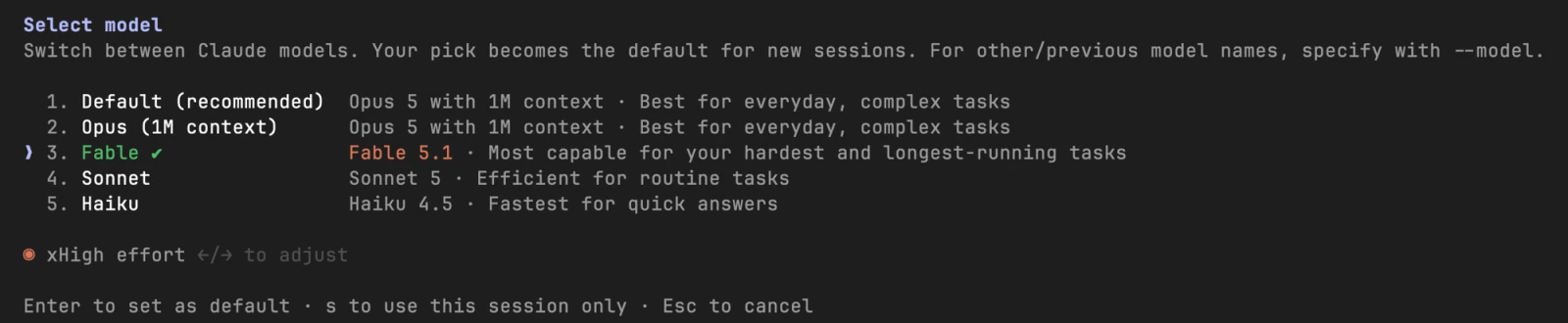
In the list, the Default is Opus 5 (1M context), and the third Fable is Fable 5.1. The description reads, "Our most capable model for the hardest, longest-running tasks." Below it are Sonnet 5 and Haiku 4.5, and Fable 5 does not appear in the list. If you want to use the previous model name, you specify it with --model. If you cannot see it yet on your end, try updating and restarting.
claude update
The default effort in Claude Code is High. As mentioned earlier, since Low or Medium delivers results equal to or better than Fable 5, you can select Fable 5.1 via /model and adjust the effort item using the left and right keys to suit the weight of your task.
Note that visibility and default behavior vary depending on your plan, provider, and administrator settings. If you are still using Claude Code via Homebrew or npm, switching to a native installation at this point will enable automatic updates, making it smoother to follow new features. Detailed steps are summarized in Switching Claude Code from Homebrew to Native Installation Made It Comfortable.
Comparison Between Fable 5 and Fable 5.1
Here is a summary of the main differences in a table.
| Item | Fable 5 | Fable 5.1 |
|---|---|---|
| Pricing (Input/Output, per 1M tokens) | $10 / $50 | $10 / $50 (Unchanged) |
| Cache read (per 1M tokens) | Previous price | $0.25 (75% reduction) |
| Terminal-Bench 4.0 | 42.0% | 55.8% |
| CursorBench 3.2.0 | 70.5% | 73.4% |
| AutomationBench | 17.1% | 31.4% |
| Vulnerability Discovery | Safeguards intervened | Available (Exploit generation, etc., redirected to Opus) |
| Cyber Safeguard Intervention | Baseline | Reduced by approx. 60% in Claude Code |
| Data Retention | Retained for 30 days at release (for safety) | Eligible customers get zero data retention (same for Fable 5). EFS starting this autumn |
| API Model ID | claude-fable-5 | claude-fable-5-1 |
Benchmark numbers are based on the comparison table in the official announcement.
What Are the Benefits for Users?
Let's reorganize the content so far from the perspective of "how it affects my work."
1. Coding benchmarks have clearly improved
An increase of 13.8 percentage points in Terminal-Bench 4.0 and 2.9 percentage points in CursorBench 3.2.0. In both areas, Opus 5 had caught up or overtaken, but Fable 5.1 has reclaimed the lead among the four models in the official comparison table. This is what pleases me the most.
2. Costs are expected to decrease for the same usage
Even though the unit prices for input/output remain unchanged, the price cut for cache reads alone is expected to reduce costs by about 25% for typical workloads and up to about 45% for agentic tasks. Furthermore, since lowering the effort to Low or Medium delivers results equal to or better than Fable 5, the reduction can be even larger. For those who felt "concerned about the cost every time they used it" with Fable 5, this is likely the most practical change.
3. Safeguard false positives will decrease
Interventions per Claude Code session are expected to decrease by about 60%, and it can now be used for vulnerability discovery. For those who were blocked during security-oriented investigations, this is a genuinely welcome improvement.
4. Consistent reports of long unattended runs
Reports from early access companies feature examples such as dozens of hours of unattended runs and tracking changes across multiple services. More than the benchmark numbers, the alignment of reports in this direction is likely to be effective in practice. However, since the company itself admits that audit visibility is not yet sufficient for very long contexts or multi-agent configurations, the premise remains that you must decide the scope and permissions to delegate yourself.
5. Data handling options become available for enterprise use
EFS opens the way to use the Fable-class with privacy equivalent to zero data retention while keeping data in your own cloud. For organizations that had passed on the top-tier model due to internal regulations, this should provide material to reconsider.
Summary
To summarize the key points of Claude Fable 5.1 and Mythos 5.1:
- Fable 5.1 and Mythos 5.1 are the same model, with the only difference being the level of safeguards. Fable 5.1 is generally available, while Mythos 5.1 is via trusted access programs.
- Terminal-Bench 4.0 went from 42.0% to 55.8% (Mythos 5.1 is 60.9%). It once again outperformed Opus 5's 52.3%.
- CursorBench 3.2.0 went from 70.5% to 73.4%.
- Lowering the effort to Low or Medium still delivers results equal to or better than Fable 5. On CursorBench 3.2.0, Fable 5.1's Low effort achieves the same level as Fable 5's High effort at about one-third of the cost (as read from the official graph).
- Terminal-Bench-Science 0.1 more than doubled, and AutomationBench went from 17.1% to 31.4%.
- Unit prices for input/output remain unchanged at $10 / $50. Cache reads are now $0.25 (a 75% reduction), resulting in cost savings of about 25% for typical workloads and up to about 45% for agentic tasks.
- Cyber safeguard interventions decreased by about 60% in Claude Code. Vulnerability discovery is now possible (exploit generation, etc., continue to be redirected to Opus models).
- Enterprise Frontier Safeguards (EFS) will gradually offer privacy equivalent to zero data retention while keeping data in your own cloud starting this autumn. EFS itself is free, and model behavior, pricing, and Rate Limits remain unchanged.
- Mythos 5.1 achieved a hit rate of approximately 50% in protein design and up to 2.5x speedup in GPU kernel optimization. Fable 5.1 created a high-resolution elevation map of Venus.
- As a model released after August 2, 2026, outputs will contain a watermark in compliance with the EU AI Act.
- The API model ID is
claude-fable-5-1. It is available on AWS, Google Cloud, and Azure starting from the announcement date.
Less than three months since Fable 5 was released. Fable, which had once been caught up to by Opus 5, has again outperformed Opus 5 on coding benchmarks, while simultaneously addressing feedback on cost and usability. While it is a different kind of surprise compared to June when the higher class became available, in terms of how much it impacts daily work, this release might actually be more significant.
I plan to set my Claude Code model to Fable 5.1 and use it thoroughly for a while. I will summarize any findings, including how to manage the Rate Limit, in another article.
Reference Links
- Introducing Claude Fable 5.1 and Claude Mythos 5.1 \ Anthropic
- Developing Enterprise Frontier Safeguards with our customers \ Anthropic
- Claude Fable 5 and Mythos 5 Released: The Class Above Opus Is Finally Generally Available
- Claude Opus 5 Released! Intelligence Approaching Fable 5 at the Price of Opus
- Claude Pricing
- Claude Code Model configuration