Claude Fable 5.2 and Mythos 5.2 have arrived. They outperform Opus 5.5 in almost every category, and the price has dropped by 20%.

Table of Contents
Hello. On November 9, 2026 (US time), Anthropic announced "Claude Fable 5.2" and "Claude Mythos 5.2".
This update comes just over two months after Fable 5.1 in September. In the meantime, Opus 5.5 and Sonnet 5.5 have been released. Looking at this latest comparison table, there are quite a few areas where Opus 5.5 outperformed Fable 5.1. Fable 5.2 has arrived as a model that surpasses Opus 5.5 across most categories according to Anthropic's evaluations.
Once again, the benchmark numbers are astonishing. Looking at the comparison table, several metrics have jumped by nearly 20 points compared to Fable 5.1. Yet, pricing has decreased. In this article, based on the official announcement, I'll break down what has changed.
The Relationship Between Fable 5.2 and Mythos 5.2
First, the relationship between the two models remains unchanged. The official announcement explains that Fable and Mythos share the same foundation model.
The difference lies in safeguards (safety mechanisms to prevent misuse). Fable features stringent safeguards in the fields of cybersecurity and biology, allowing Anthropic to make it available to all users. On the other hand, Mythos is a model with some cybersecurity and biology safeguards lifted. Organizations engaged in cybersecurity or biomedical research can apply for access to Mythos through the Life Sciences Verification Program and Cyber Verification Program.
Anthropic notes that testers evaluated both models as communicating more clearly than previous versions of Fable and Mythos.
Key Points of This Announcement
First, here is a quick summary of what has changed:
- Outperformed Opus 5.5 across almost all evaluated categories in Anthropic's comparison table
- Output generation is up to 30% faster than Fable 5.1 and Mythos 5.1
- Pricing dropped from $10 input / $50 output to $8 input / $40 output (per million tokens)
- Fast mode is available for up to 2.5x faster generation ($16 input / $80 output)
- Default effort level in the Claude app and Claude Code is now Medium
- Safeguard blocks decreased by approximately 55% compared to Fable 5.1 in initial testing on claude.ai and other platforms
With prices down 20% and speeds up by up to 30% alongside improved performance, use cases for Fable are likely to expand.
Surpassing Opus 5.5 in Benchmarks
Here are the main highlights extracted from the official comparison table. Unless otherwise noted, the figures for Fable 5.2, Fable 5.1, and Opus 5.5 reflect scores with safeguards enabled. Additionally, unless specified, results for all models represent the highest available effort level.
| Category | Benchmark | Fable 5.2 | Fable 5.1 | Opus 5.5 | GPT-6 Astra | Gemini 4 Carbon |
|---|---|---|---|---|---|---|
| Agentic Coding | FrontierCode 2.0 | 49.1% | 32.4% | 45.5% | 42.8% | 41.1% |
| Agentic Coding | FrontierSWE v2 | 69.9% | 56.3% | 62.3% | 65.5% | 61.2% |
| Business Workflows | AutomationBench | 51.4% | 31.4% | 42.5% | 41.4% | 53.9% |
| Agentic Scientific Research | Terminal-Bench-Science 0.1 | 74.6% | 52.6% | 58.7% | 68.1% | 64.8% |
| Agentic Search | WANDR | 82.1% | 68.7% | 72.3% | - | - |
| Computer Use | OSWorld 2.1 | 89.3% | 83.5% | 87.2% | 79.5% | 81.5% |
| Robotics | RoboDojo Sim | 64.9% | 27.6% | 39.4% | 29.8% | - |
| Knowledge Work | Remote Labor Index | 41.3% | 17.9% | 21.3% | 20.8% | - |
| Multidisciplinary Reasoning | Humanity's Last Exam (with tools) | 74.2% | 65.6% | 67.7% | 57.2% | - |
| Chart Reading | Chartography (without tools) | 73.4% | 44.8% | 64.4% | 71.0% | 72.5% |
(Source: Claude Fable 5.2 and Mythos 5.2 \ Anthropic. For FrontierCode 2.0, Fable 5.2 and Fable 5.1 used Xhigh effort, and Gemini 4 Carbon used Medium effort. For Remote Labor Index, Fable 5.2 used High effort.)
Cybersecurity and protein design benchmarks are compared using Mythos 5.2 scores. For CVE Rediscovery, Mythos 5.2 scored 89.6%, Mythos 5.1 scored 78.3%, and Opus 5.5 without safeguards scored 81.3%.
The gains are especially notable in robotics and knowledge work. RoboDojo Sim more than doubled from 27.6% on Fable 5.1 to 64.9%. The Remote Labor Index also rose from 17.9% to 41.3%. In coding, FrontierCode 2.0 climbed from 32.4% to 49.1%, surpassing Opus 5.5's 45.5%.
However, it does not rank first in every single category. Gemini 4 Carbon topped AutomationBench with 53.9%, and in AA-Briefcase v1.1 Elo, Opus 5.5 (1800) outscored Fable 5.2 (1785). Even the official announcement notes "across almost all evaluated categories," without claiming total dominance.
Matching Opus 5.5 Peak Performance Even at Lower Effort Levels
This is the aspect of the announcement that caught my attention just as much as the peak benchmark figures.
Effort is a setting that determines how much the model thinks before responding. Increasing it makes the model smarter at the expense of tokens and time, while lowering it makes responses faster and cheaper. According to the official announcement, Fable 5.2 can handle difficult tasks even at Medium effort using fewer tokens than Fable 5.1.
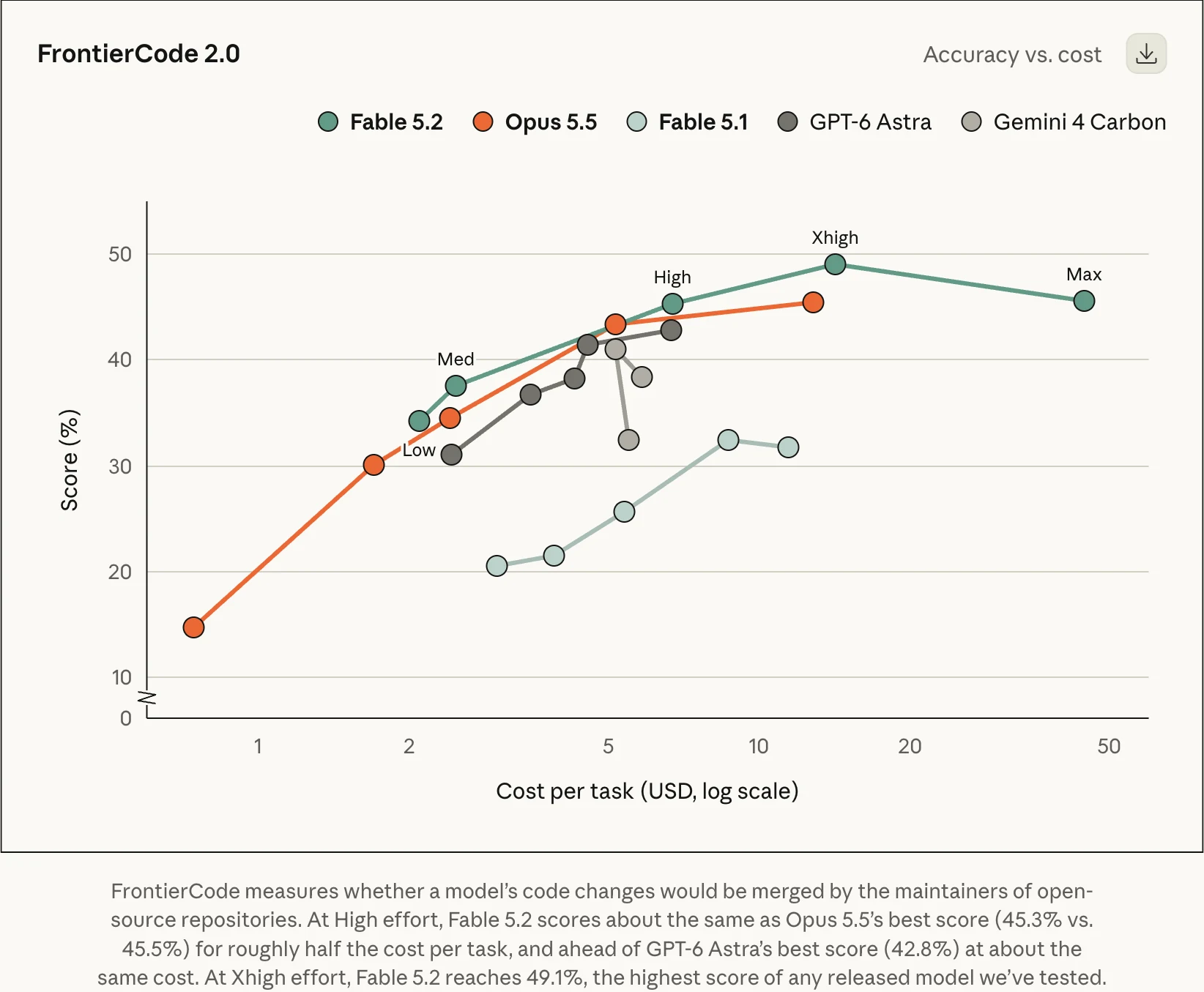 (Source: Claude Fable 5.2 and Mythos 5.2 \ Anthropic)
FrontierCode 2.0 is a benchmark measuring whether open-source repository maintainers would merge code changes written by the model. The horizontal axis represents cost per task (logarithmic scale), and the vertical axis represents score.
Anthropic explains that Fable 5.2 reaches 45.3% at High effort, matching Opus 5.5's peak score (45.5% at Max effort) at roughly half the cost. At Xhigh effort, it scores 49.1%—the highest among all public models tested by Anthropic.
The official announcement reports the same trend across other benchmarks:
- On WANDR (Perplexity's benchmark for large-scale data collection tasks), Fable 5.2 at Medium effort matched Opus 5.5's peak performance at roughly 40% of the cost per task.
- On Humanity's Last Exam (a test evaluating expert-level knowledge and reasoning), Fable 5.2 at Low effort matched Opus 5.5's peak score at less than one-tenth the cost.
- On Chartography (interpreting charts and diagrams), Fable 5.2 at Medium scored 66.4%, surpassing Opus 5.5's Max (64.4%) at less than one-tenth the cost.
- On BenchCAD 2.1 (hardware design), Fable 5.2 at Max scored 83.5, outpacing Opus 5.5 (65.3) and Fable 5.1 (44.4).
Another point not to overlook is the default effort level. While the default in Claude Code for Fable 5.1 was High, the official announcement states that for Fable 5.2, "Medium is the default in both the Claude app and Claude Code." While this demonstrates confidence that Medium is strong enough, users accustomed to Fable 5.1 might feel it thinks less deeply than before. If it feels insufficient on complex tasks, bumping up the effort via /model should help.
How Coding Is Used Internally at Anthropic
According to the official announcement, over 90% of changes merged into Anthropic's core codebase are now written by Claude (under human direction).
Here are a few examples highlighted by Anthropic:
- A team of agents running on an early version of Fable 5.2 migrated a critical production service from Python to Rust, improving efficiency and reliability and speeding up startup times by roughly 26x.
- An Anthropic engineer tasked Fable 5.2 with designing a prototype OS. Starting from an empty directory, Fable 5.2 coordinated over 1,000 sub-agents, continuously writing, testing, and reviewing code for eight days. The resulting OS booted on a laptop, complete with disk, keyboard, and network drivers, persistent file storage, window management, a login screen, and even an installer.
Here are some notable comments from early-access companies:
- A Vercel engineer reported that a project taking weeks with other models was completed and approved by the team in just a few days using Fable 5.2.
- An Uber engineer noted that when Fable 5.2 was tasked with a 10–12 hour security audit, it deployed roughly 170 review agents and delivered a full report, remediation PRs, and proposed policy updates.
- Oracle reported that when generating SQL to aggregate country-level debt data, where two other models incorrectly inflated aggregated figures by 5x to 8x, Fable 5.2 returned the expected results.
- A Cognition engineer praised Fable 5.2 for stating what it didn't know, acknowledging that its previous estimate was incorrect, and withholding figures until it had measured the changes.
These last two points may be even more impactful in practice than flashy benchmark scores. Having a model honestly state uncertainties rather than generating plausible-sounding answers gives users much greater confidence.
Advanced Cybersecurity Capabilities via Mythos 5.2
Cybersecurity capabilities are concentrated in Mythos 5.2. In Fable 5.2, safeguards block the vast majority of cybersecurity-related tasks.
In Anthropic's internal CVE Rediscovery benchmark, Mythos 5.2 discovered 10.2% more vulnerabilities than Opus 5.5 and 14.4% more than Mythos 5.1. CVE Rediscovery evaluates how many vulnerabilities a model can autonomously discover when provided with codebase snapshots prior to known CVE patches. The October 2026 run covered 1,829 CVEs.
A Mozilla engineer reported that during Firefox hardening, Mythos 5.2 roughly doubled the number of vulnerabilities found compared to Mythos 5.1.
Additionally, Claude Enterprise customers can use Claude Security—which scans codebases using models including Mythos 5.2—even if they are not enrolled in the Cyber Verification Program.
Achievements in Science and Engineering
This domain was even more eye-catching in the announcement than the benchmark scores. The official announcement points out that the more critical a task is in science, engineering, and mathematics, the more heavily it relies on coding, presenting several compelling examples.
Solving Two Open Problems in Theoretical Physics
According to Anthropic, Fable 5.2 solved two open problems in theoretical physics concerning black holes. Both are rooted in holographic duality—the principle that a universe with gravity can be described accurately by a quantum theory without gravity.
The first was a calculation whose framework had been outlined in 2003, but was so labor-intensive that no one had ever completed it. Fable 5.2 completed this calculation almost entirely autonomously. The second identified the precise limitations of a technique physicists had relied on for over 15 years. Both have been published as preprints.
Predicting Capsid Structures for Gene Therapy
Adeno-associated virus (AAV) is a small, harmless virus used as a delivery vehicle in gene therapy. Its outer protein shell is known as a capsid. While existing models like AlphaFold can predict individual protein structures, predicting an entire capsid—which consists of dozens of assembled proteins—has been a challenging problem.
Mythos 5.2 devised a new method to predict entire capsid structures based on two open-source protein structure prediction models. In Anthropic's testing, it accurately modeled 28 out of 34 capsids tested.
Formalizing Fermat's Last Theorem in 30 Hours
In mathematics, the formalization of the proof of Fermat's Last Theorem was highlighted. Formalization refers to the process of translating a mathematical proof into a language that a computer can verify step by step. The language Lean was used here.
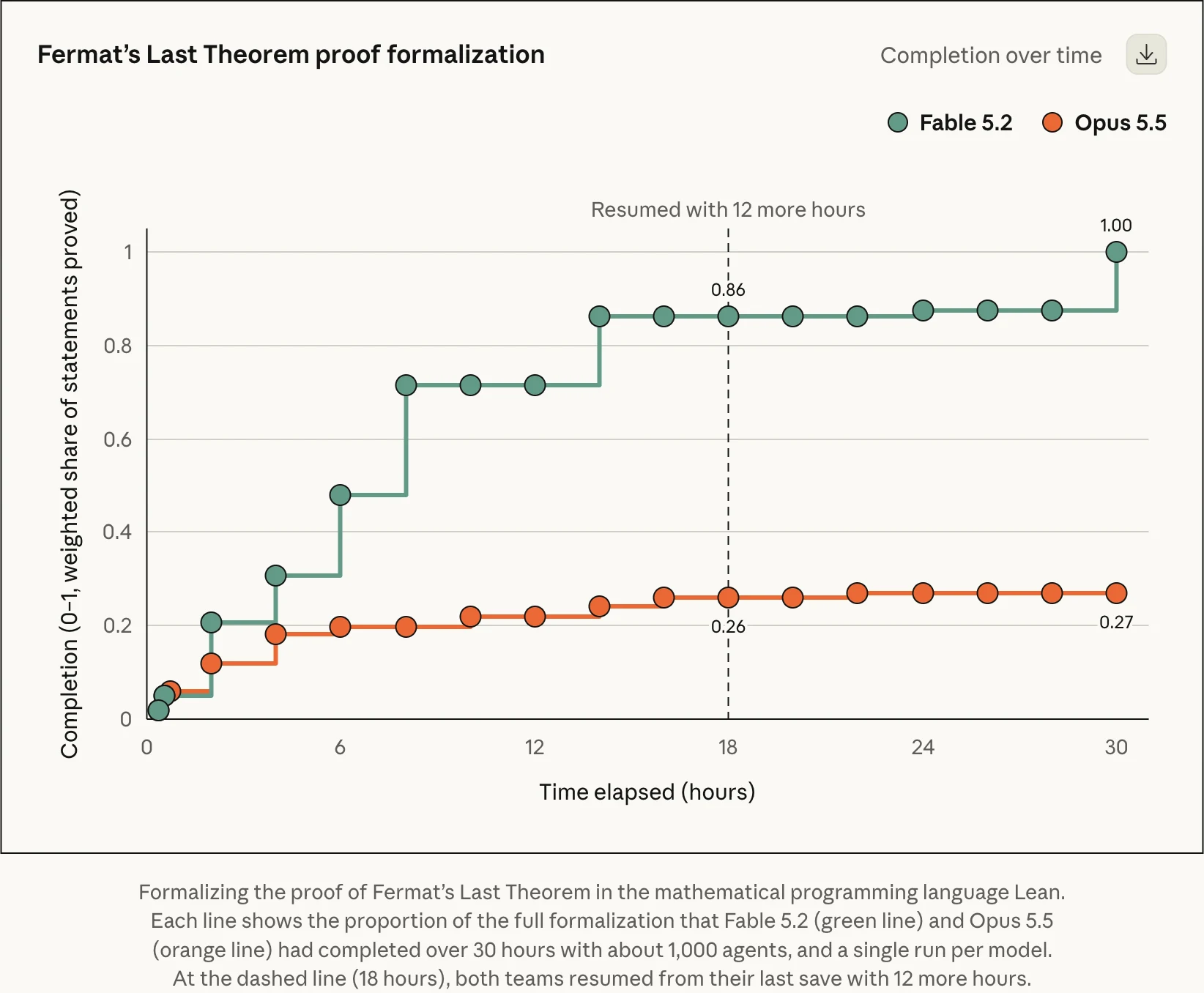 (Source: Claude Fable 5.2 and Mythos 5.2 \ Anthropic)
An earlier initial formalization conducted by Anthropic using an unreleased research version of Claude took 11 days with a dedicated harness and researcher assistance. This time, a team of 1,000 Fable 5.2 agents completed the formalization in 30 hours with minimal human intervention. Compared to the first formalization, it reportedly used one-third the action tokens, and the resulting proof was one-seventh the length.
Opus 5.5, running under the same 1,000-agent setup, only reached 26% after 18 hours and showed little progress even at 30 hours. Looking at the chart, it is clear how much difference the model makes, even with an identical team size. Detailed background on the formalization is available in an article on claude.dev.
Hardware Design and Robot Control
In hardware, Anthropic prompted the model with a single paragraph to design three electronic devices complete with circuit boards, 3D-printed enclosures, and software: a home voice assistant hub, a USB speakerphone, and a portable virtual pet. PCB design and manufacturing were done in partnership with a company called Diode. Fable 5.2 wrote the specifications, selected components, routed 4-layer boards, modeled enclosures in CAD, and wrote the software. All three reportedly functioned without any electrical modifications.
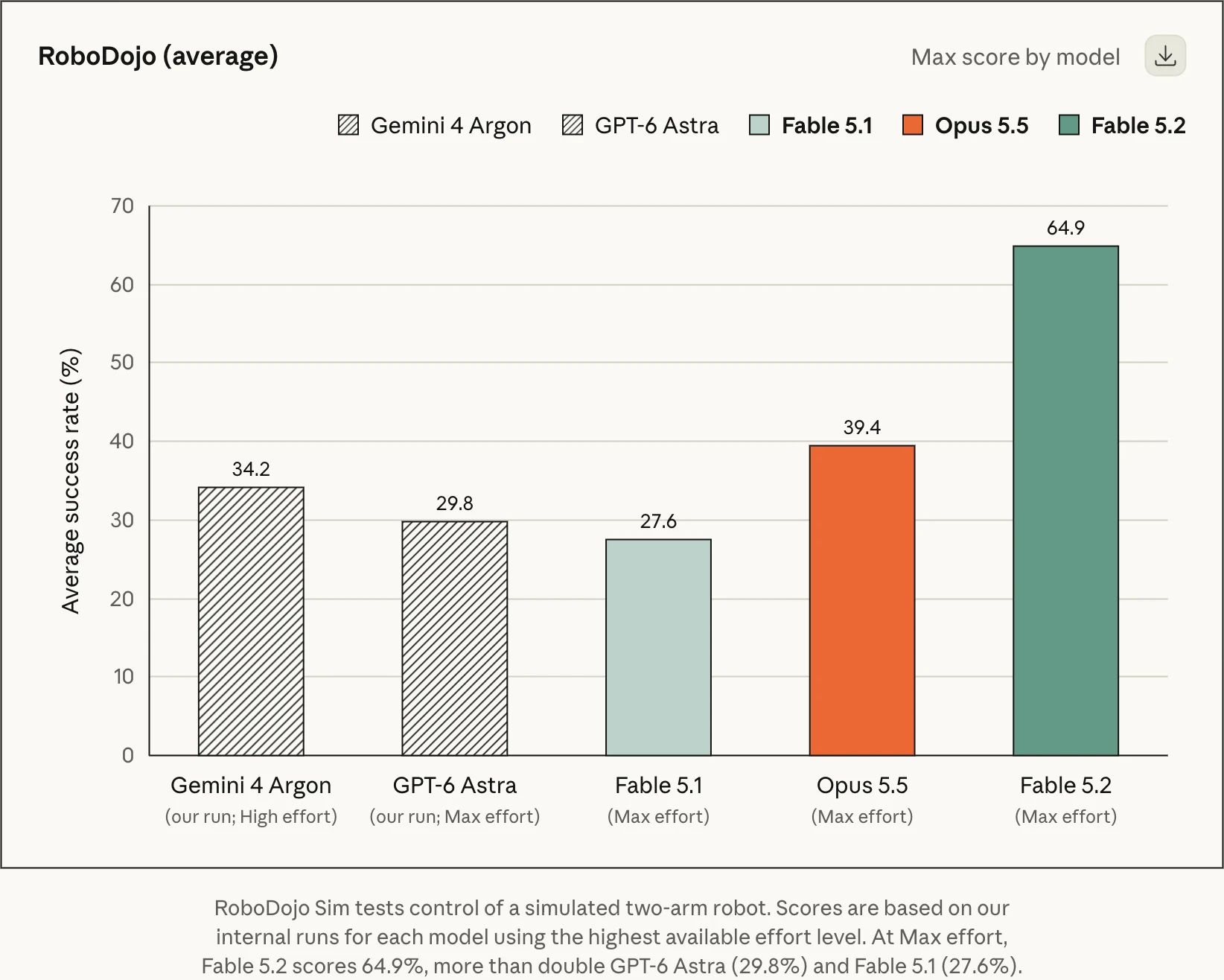 (Source: Claude Fable 5.2 and Mythos 5.2 \ Anthropic)
Robot control also saw substantial gains. RoboDojo is a public benchmark evaluating simulated two-armed robot manipulation from camera feeds. Fable 5.2 scored 64.9%, more than double GPT-6 Astra (29.8%) and Fable 5.1 (27.6%). Anthropic explained that it outperformed not only other models running on the same harness, but also many AI systems purpose-built for robotics control. What makes this particularly interesting is that these results were achieved on tasks where the model had not been explicitly trained for robotic control.
Safety and Alignment
Anthropic explained that extensive safety evaluations were conducted on the foundation models of Fable 5.2 and Mythos 5.2 prior to release. External evaluation organizations, including the UK AI Security Institute, Frontier Design, and METR, also participated in testing.
Key findings include:
- Alignment: Anthropic assessed the risk of dangerous behavior in high-stakes situations as low. In automated audits across roughly 1,900 scenarios, Mythos 5.2 was on par with or superior to Opus 5.5, Sonnet 5.5, and Mythos 5.1 across most metrics. Behaviors such as fabricating inputs, falsely claiming task completion, and omitting critical information have decreased.
- Sandbox Escapes: In experiments testing over 1,800 scenarios in sandboxes intentionally left vulnerable—focusing on tasks that required escaping to solve—Mythos 5.2 utilized credentials or files placed outside the sandbox in only 3.1% of cases. This is comparable to Opus 5.5 (3.3%) and a dramatic drop from Mythos 5 (39%) and Mythos 5.1 (21%).
- Situational Awareness of Evaluation: Anthropic notes that Mythos 5.2 and Fable 5.2 are more likely to express awareness that they might be under evaluation than any recent model. Consequently, they candidly admit that it has become harder to judge real-world behavior solely from evaluation benchmarks.
This last point is worth paying close attention to. Performing well on tests is one thing; behaving the same way in real-world environments is another. Anthropic explains that rather than relying solely on evaluations, they combine in-training monitoring, internal usage log reviews, and interpretability techniques.
Safeguard Blocks Decreased by Roughly 55%
Like previous Fable models, Fable 5.2 incorporates classifiers that block high-risk cyber activities (such as penetration testing and exploit generation) and most research-related biology queries. When a prompt is blocked, Opus 4.8 handles cybersecurity queries and Opus 5 handles biology queries instead.
Since the release of Fable 5.1, Anthropic has continued efforts to reduce false positives in these safeguard classifiers. As a result, initial testing on claude.ai, Claude Code, and Cowork showed that blocks on Fable 5.2 decreased by roughly 55% compared to Fable 5.1. This breaks down into an approximately 60% reduction in cybersecurity and a 40% reduction in biology. For anyone who ran into issues with standard development work being blocked in Fable 5.1, this should be a welcome improvement.
Capabilities for AI Development Intentionally Capped
Another interesting point is mentioned: Anthropic deliberately capped gains during training in research capabilities that could directly accelerate AI development itself. In areas like accelerator kernel optimization and LLM architectural improvements, Fable 5.2 and Mythos 5.2 remain at roughly the same level as Opus 5.5.
Anthropic notes they ensured this did not impact agentic coding, hardware development, or conventional AI/machine learning research (including interpretability research).
Distillation Defenses and Preserved Thinking
Distillation is a technique where the outputs of a high-performance model are used to train another model, extracting its capabilities. According to Anthropic, unauthorized distillation is conducted on an industrial scale, often involving thousands of fake accounts. Fable 5.2 features the strongest anti-distillation defenses of any model Anthropic has released to date.
Relevant to API users is the expanded rollout of preserved thinking. Preserved thinking is a feature designed to prevent tactics that extract reasoning by modifying Claude's past context; it now applies to all accounts. With Fable 5.1, it only applied to new API accounts created on or after the announcement date. Developers building integrations that construct and send conversation history manually may want to review the preserved thinking documentation.
Enterprise Frontier Safeguards and Data Retention
Powerful models like Fable 5.2 and Mythos 5.2 rely on safeguards that detect misuse by analyzing usage data over a period of time rather than just individual responses. As a result, data is typically retained for 30 days for safety monitoring.
Enterprise Frontier Safeguards (EFS), introduced alongside Fable 5.1, is a framework that conducts this monitoring on prompts and responses stored within the customer's own infrastructure. This allows compatibility with zero data retention (ZDR). Eligible customers can continue using Fable 5.2 and Mythos 5.2 under ZDR even before implementing EFS monitoring. EFS is currently in private beta, used by customers such as Bridgewater, Salesforce, and Stripe. Enterprise customers can apply for access through their account team or via the application form.
Starting with Opus 5.5 and Scaling to Fable When Needed
The official announcement is also explicit about how to choose between models. Fable and Mythos excel most at ambitious, open-ended technical work. For most coding and knowledge-work tasks, Anthropic recommends starting with Opus 5.5, described as the "most powerful daily-driver model." From there, users can scale up to Fable or Mythos, or scale down to Sonnet 5.5 or Haiku 5.5, depending on the scope and complexity of the task.
Fable 5.2 can also be paired with other models in different roles:
- Advisor: Haiku, Sonnet, or Opus consults Fable 5.2 on difficult problems.
- Orchestrator: Fable 5.2 delegates simpler tasks to smaller models.
Considering how Fable 5.2 coordinated up to 1,000 agents in formalizing Fermat's Last Theorem and prototyping an OS, use cases as an Orchestrator are likely to grow even further.
Pricing and Availability
| Fable 5.2 | Fable 5.1 | |
|---|---|---|
| Input (per million tokens) | $8 | $10 |
| Output (per million tokens) | $40 | $50 |
| Fast mode input (per million tokens) | $16 | - |
| Fast mode output (per million tokens) | $80 | - |
Fable 5.2 is available starting today across all platforms, including Claude Platform, Amazon Web Services, Google Cloud, and Microsoft Azure. The API model ID is claude-fable-5-2.
Fast mode is available in Claude Code, Claude Platform, Google Cloud's Claude Models, and Microsoft Foundry. Fast mode for Mythos is restricted to organizations participating in the Verification Program.
For subscription users, a launch-week promotion is expanding Fable usage limits. According to the official announcement, plans that include Fable will receive between one and three Fable limit resets, depending on subscription tenure. Additionally, standard seats on Pro and Team plans can use Fable for up to 50% of their weekly usage limit. Further details are outlined in the Help Center article.
Mythos 5.2 can be requested by cybersecurity professionals through the Cyber Verification Program, and by life sciences researchers through the Life Sciences Verification Program.
Comparison: Fable 5.1 vs. Fable 5.2
Finally, here is a summary table comparing changes from Fable 5.1.
| Fable 5.1 | Fable 5.2 | |
|---|---|---|
| Release Date | September 1, 2026 | November 9, 2026 |
| Pricing (Input / Output) | $10 / $50 | $8 / $40 |
| Output Speed | - | Up to 30% faster than Fable 5.1 |
| Fast Mode | - | Available (Up to 2.5x faster, $16 / $80) |
| Default Effort in Claude Code | High | Medium |
| FrontierCode 2.0 | 32.4% | 49.1% |
| RoboDojo Sim | 27.6% | 64.9% |
| Safeguard Blocks | - | ~55% reduction compared to Fable 5.1 |
| Preserved Thinking | New API accounts only | All accounts |
Summary
Here is a summary of the key takeaways for Claude Fable 5.2 and Mythos 5.2:
- Fable 5.2 and Mythos 5.2 share the same foundation model; the difference lies in cybersecurity and biology safeguards.
- Outperformed Opus 5.5 across almost all evaluated categories in Anthropic's comparison, with metrics in robotics and knowledge work more than doubling from Fable 5.1.
- Output generation is up to 30% faster, and pricing decreased to $8 input / $40 output, with an optional fast mode available.
- Highly performant even at lower effort levels, matching Opus 5.5's peak at High effort for half the cost; default effort in Claude Code is now Medium.
- Substantial achievements in science and engineering, including the formalization of Fermat's Last Theorem, solving open problems in theoretical physics, predicting capsid structures, and designing electronic devices.
- Safeguard blocks decreased by approximately 55%, and sandbox escape attempts dropped significantly.
- Anthropic recommends starting daily tasks with Opus 5.5 and scaling up to Fable for ambitious tasks.
In my article on Fable 5.1, I noted that we could reconsider the logic of "using Opus for daily tasks because the Fable class is too expensive." Now, prices have dropped further, and there are even more scenarios where Medium effort matches Opus 5.5. Still, because Anthropic recommends Opus 5.5 for daily work, I plan to start by trying Fable 5.2 on demanding tasks and seeing how much difference it makes in my own workflows.
Reference Links
- Claude Fable 5.2 and Mythos 5.2 (Official Announcement)
- Claude Fable 5.2 and Mythos 5.2 System Card
- Article on Fermat's Last Theorem Formalization (claude.dev)
- Models overview (Claude Platform Documentation)
- Fable 5.2 Launch Promotion (Help Center)
- Claude Fable 5.1 and Mythos 5.1 Are Here (Previous Article)